

Retail RFID Requirements: What Brands Need to Know

RFID adoption is expanding across retail, bringing new requirements for brands that sell through major retailers. For many suppliers, that means adding RFID technology to individual products and packaging, managing serialized product data, and making sure RFID tags meet retailer performance standards.
But preparing for retail RFID requirements involves more than simply adding an RFID label.
Brands need to understand which products are affected, how products will be tagged, who will manage serialization, where RFID will be applied, and how the finished product will be tested for compliance.
The good news is that RFID technology and the systems supporting it have come a long way. Brands also have more options for integrating RFID into their existing packaging than they did during earlier stages of retail RFID adoption.
Here’s what brands should know as retail RFID adoption continues to grow.

What Are Retail RFID Requirements?
Retail RFID requirements are guidelines established by retailers that require certain products to use radio frequency identification (RFID) technology for item-level identification and tracking.
Rather than identifying only a product type, item-level RFID can give individual products a unique serialized identity.
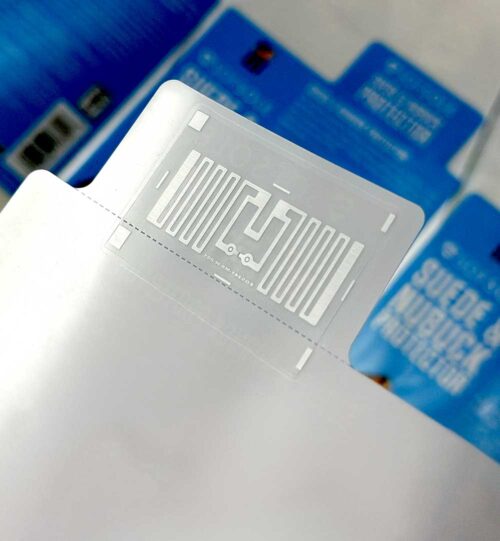
For brands subject to a retailer’s RFID program, requirements may specify the type of RFID inlay that can be used, how the tag should be encoded, where it should be placed on the product or packaging, including pressure-sensitive labels and folding cartons. and how its performance must be validated.
According to Chris Brown, RFID Program Director at TSC, brand owners are responsible for making sure their products use the correct RFID tags and encoding. That responsibility remains with the brand even when production involves multiple contract manufacturers or suppliers.
That makes RFID compliance a packaging, data, operations, and supply chain consideration rather than simply a labeling change.
Why Are Retailers Adopting RFID?
One of RFID’s biggest advantages in retail is inventory visibility.
Unlike a traditional barcode or QR code, an RFID tag does not require direct line of sight to be read. Multiple tagged products can also be identified without individually scanning every package.
This can help retailers use product-level data to support:
- Inventory accuracy
- Out-of-stock reduction
- Product location and tracking
- Omnichannel fulfillment
- Supply chain visibility
- Inventory planning
RFID can provide greater visibility into products moving through warehouses, distribution networks, and retail environments. Shaun Stigall, of Tageos, and an RFID expert with more than two decades of industry experience, highlighted the value of using this data to understand inventory levels, product movement, and operational bottlenecks. That data can help organizations better understand how much inventory they have and where it is located.
The business case has also changed as RFID technology has matured. According to the webinar panel, costs associated with tags, chips, printing and encoding equipment, and readers have decreased as manufacturing volumes and technology have improved.
What Is a Brand Responsible for With RFID?
The brand owner is generally responsible for making sure its products meet the applicable retailer RFID requirements.
That can become more complicated when a brand relies on multiple contract manufacturers, packaging suppliers, or production locations.
A brand may need to coordinate:
- RFID tag or inlay selection
- Product and packaging compatibility
- Tag placement
- RFID encoding
- Unique serialization
- Data management
- Testing and validation
- Implementation across manufacturing partners
For example, if a brand uses several contract manufacturers to produce the same product, it still needs a way to control serialized numbers across those manufacturers and prevent duplication.
This is why RFID implementation often involves more than the packaging team. Operations, IT, supply chain, quality, procurement, manufacturing partners, and packaging suppliers may all play a role.
Aqueous is particularly useful when the coating isn’t supposed to become the visual centerpiece of the package. Instead, it protects and complements the printed graphics.
What Is RFID Serialization?
RFID serialization gives individual items a unique identifier instead of using the same identifier for every unit of a particular product.
Enzo Papalia, President of The New Label, describes RFID serialization simply as assigning a unique number to each individual item. Those numbers must then be managed to prevent the same serialized identifier from being reused. Those numbers then need to be managed so the same serialized identifier is not unintentionally reused.
GS1 standards provide a standardized framework for RFID encoding, helping brands, suppliers, technology providers, and retailers exchange product information consistently.
For brands with complex SKU portfolios or multiple manufacturing partners, serialization management can therefore become an important part of the RFID implementation process.

What Are ARC and ALEC?
Brands preparing for retailer RFID requirements may encounter ARC and ALEC, programs associated with Auburn University’s RFID Lab.
As Shaun Stigall explained, ARC establishes performance criteria for RFID tags used with different types of products. Products fall into specific performance categories that help determine which RFID inlays are appropriate for the application. Products can fall into specific performance categories, helping determine which RFID inlays are appropriate for the application.
ALEC is part of the product-level validation process. The panel described it as a way to verify factors such as tag placement and encoding before implementation.
The distinction can be simplified as:
ARC: Is the RFID inlay designed to meet the required performance criteria?
ALEC: Does the RFID implementation work correctly on the actual product?
Understanding both can help brands determine which RFID technology to use and how to validate the finished application.
How Does the Retail RFID Compliance Process Work?
Exact requirements depend on the retailer and product category, but brands can generally expect a process that moves from identifying applicable RFID requirements through inlay selection, testing, validation, and production.
A retailer first identifies the products that need RFID and specifies the applicable ARC-approved inlay categories. The supplier can then select an appropriate inlay, create test labels, encode the required information, and apply the labels to the products.
Samples, photographs, videos, or other required information can then be submitted through the applicable validation process. The implementation is reviewed for factors such as tag placement and encoding before the supplier moves into production.
In simplified form:
Retailer requirement → RFID inlay selection → RFID label development → encoding and serialization → tag placement → testing and validation → production
Brands should always follow the current requirements provided by their retailer rather than assuming the process is identical across programs.
Where Should an RFID Tag Be Placed?
There is no single RFID tag placement that works for every product.
The product itself, packaging materials, liquids, metals, package dimensions, surrounding products, and retail environment can all affect RFID performance.
This is one reason brands should consider RFID requirements during packaging development rather than after packaging has already been finalized.
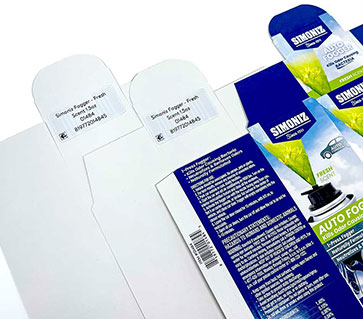
An RFID solution also doesn’t necessarily need to look like a plain white label added to an otherwise finished package. RFID integration has also evolved beyond simply applying a plain white RFID label to a finished product. Kent Madson of Meyers notes that brands now have more options for incorporating RFID into retail packaging while considering both performance and package design.
Working with packaging and RFID partners early can help determine an application that meets performance requirements without unnecessarily compromising package design or brand presentation.

Does Every SKU Need an RFID Label?
Not necessarily. RFID requirements can be retailer- and SKU-specific.
Mark Potter, Director of Sales at Meyers, has seen brands take a retailer-specific approach to RFID implementation. Rather than immediately adding RFID to every product, a brand may initially implement RFID on SKUs going to the retailer that requires it.
As additional retailers adopt RFID, brands can expand implementation across more SKUs where it makes operational and financial sense.
Brands should therefore begin by identifying:
Which retailers require RFID? Which product categories are affected? Which SKUs go to those retailers?
That inventory can help establish the scope of an RFID implementation before changes are made across an entire product portfolio.
Should Brands Wait Until a Retailer Requires RFID?
Waiting for a retailer notification can reduce the amount of time available to test and implement an RFID solution.
Brands don’t necessarily need to wait for a formal retailer notification to begin preparing. Enzo Papalia recommends evaluating RFID requirements early, particularly for brands with complex SKU portfolios or multiple departments and manufacturing partners that will need to participate.
That doesn’t necessarily mean immediately converting every product to RFID.
Instead, brands can start by understanding their exposure and preparing the people, packaging, data, and processes that would be affected.
How Can Brands Prepare for Retail RFID Requirements?
Brands preparing for RFID can start with a few fundamental questions:
- Which retailers and SKUs could be affected? Review current retailer requirements and identify products sold through those channels.
- Who owns RFID internally? Determine who will coordinate packaging, operations, supply chain, IT, quality, and manufacturing partners.
- How will serialization be managed? Establish responsibility for generating, distributing, and controlling unique identifiers.
- How will RFID be incorporated into the packaging? Evaluate label construction, inlay selection, placement, package design, and product characteristics.
- How will the application be validated? Understand applicable ARC performance specifications, retailer guidelines, and testing requirements.
- Can the RFID data provide value beyond compliance? Consider how item-level data could support inventory visibility, fulfillment, supply chain management, and other operations.
Starting with these questions can turn RFID from a last-minute packaging change into a more manageable implementation plan.

RFID Is More Than a Retail Requirement
For brands, the immediate reason to implement RFID may be retailer compliance. But the technology can also create access to item-level data that traditional product identification methods cannot provide as efficiently.
RFID can support greater visibility into inventory and product movement because individual items can be identified without scanning each barcode individually.
As adoption expands, that distinction could make RFID an increasingly important part of the connection between physical packaging, product data, supply chains, and retail operations.
Papalia describes RFID as part of a broader evolution toward smarter packaging, where packaging does more than identify and protect a product. It can also become a source of usable product-level data.
Preparing Your Packaging for RFID
Implementing RFID doesn’t have to mean navigating packaging, inlays, encoding, and testing independently.
Meyers works with consumer brands to develop custom ARC approved RFID labeling solutions that integrate RFID technology into retail-ready packaging. By considering the RFID application alongside label construction, printing, encoding, and packaging requirements, brands can prepare for retailer requirements while maintaining the performance and presentation their products need.
Explore Meyers RFID Labels & Solutions →
Frequently Asked Questions About Retail RFID Requirements
Retail RFID requirements are guidelines established by retailers that require certain products to use RFID technology for item-level identification and tracking. Requirements may specify approved RFID inlays, encoding and serialization, tag placement, testing, and performance criteria.
No. RFID requirements can vary by retailer, product category, and SKU. Brands may initially add RFID only to SKUs going to a retailer that requires it, then expand RFID to additional products as requirements or business needs change. This retailer-specific approach is one Meyers has seen brands use when implementing RFID.
RFID serialization assigns a unique identifier to each individual item. These identifiers must be managed to prevent duplicate serial numbers, particularly when a brand uses multiple manufacturing locations or partners. GS1 provides standardized formats that help support consistent RFID encoding and serialization.
ARC establishes performance criteria that help determine which RFID inlays are appropriate for specific product applications. ALEC supports product-level validation, including checking factors such as RFID label placement and encoding to confirm the application performs as required.
There is no single RFID label placement that works for every product. Placement depends on the product, packaging, RFID inlay, and applicable performance requirements. The finished application should be tested to confirm that the RFID tag can be read properly in its intended environment.
Brands don’t necessarily need to wait for a formal retailer notification. Preparing early can provide more time to identify affected SKUs, coordinate internal teams and manufacturing partners, determine how RFID will be incorporated into packaging, establish serialization processes, and complete required testing.