Conductive Ink Printer

Why Choose Meyers for Your Conductive Ink Printing?

HIGH VOLUME MANUFACTURING

Scale your business by using our highly cost-effective roll-to-roll process to manufacture your printed electronics parts. 

COLLABORATION

We will work with you to design effective solutions and develop a scalable process with a keen eye toward speed to market. 

EXPERIENCE

The world’s foremost technical, medical, and aerospace companies trust us with their conductive ink screen and flexographic printing.  

Meyers’ Function47 Conductive Ink Printing

Ready to explore the endless potential of printing with conductive ink? Click below to visit our website dedicated to Meyers’ conductive ink division, Function47. Discover how our team of experts can collaborate with you to bring your ideas to reality.

About Our Roll-to-Roll Printed Electronics Expertise

Conductive Ink Printer
Engineering

Engineering a custom manufacturing process specifically tailored to your products and your requirements is not easy. That’s why leading aerospace, medical device, and electronics brands work with Meyers. We’re not just any conductive ink printer. Our in-house engineering team will help you evaluate your production methods to ensure you can meet your specifications at scale. Our team’s expertise extends to general, electrical, and mechanical engineering, so we can appreciate all facets of your requirements and understand your application. We focus on the custom solutions necessary to deliver the most bold and innovative products. If you are looking for a component that does not exist on the open market and you need it made at scale, we are the partner for you.   

From POC to Production

Creating a successful proof of concept (POC) is a huge step in the product development cycle. We’re here to make sure you’re even more successful while scaling up the production of your printed electronic components. We’ve walked this path with some of the most well-known technology companies on the planet and we’re excited to continue helping new companies transition from POCs to high-volume production.  

Most printed electronics are made with conductive inks leverage etching and flatbed screen printing for a POC and continue using those techniques in low-volume production. As production ramps up, companies typically find that etching and flatbed screen printing have major limitations at higher volumes. Instead, you need a roll-to-roll printed electronics manufacturing partner to continue growing your operations. Because of its throughput capacity, roll-to-roll is optimal for producing high volumes cost-effectively. Our roll-to-roll processes include highly accurate, tight tolerance converting, and die-cutting. 

The engineering team and manufacturing facility are conveniently located in Minneapolis, bringing the many benefits of working with domestic suppliers. And, since we offer both screen and flexographic roll-to-roll conductive ink printing services, we can help you understand the best path forward, build that process, and execute that manufacturing process, all under one roof. 

Client Testimonials

“We bring these opportunities to Meyers because of the trust they’ve built over years of working together.”

Leading Medical Products Company

“You guys are one of our foremost suppliers.”

Leading Aerospace Company

Contact Us for More Information About Conductive Ink Printing

FAQs

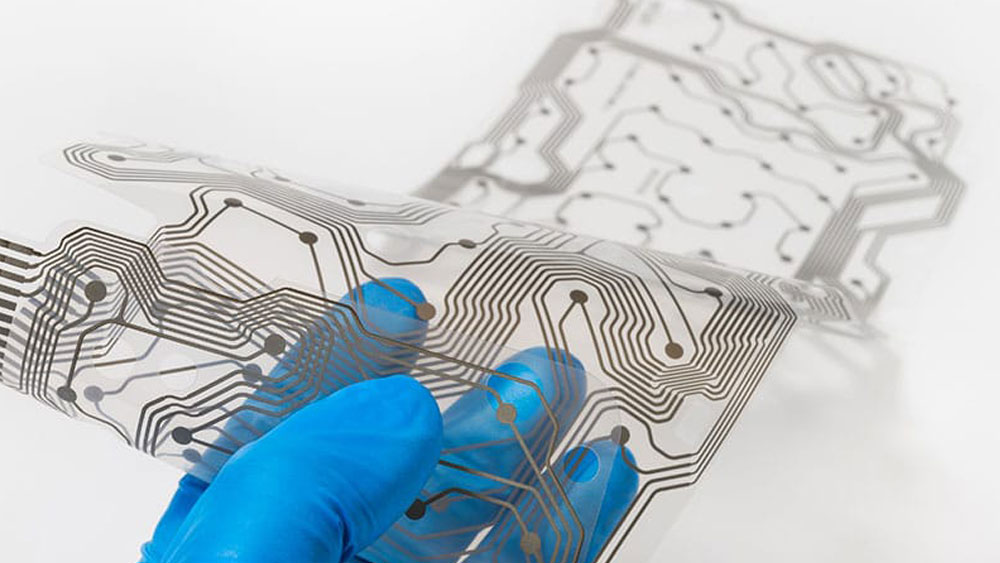
Conductive ink is a specially formulated ink that conducts electricity, allowing circuits and sensors to be printed directly onto packaging or other materials. It’s an important part of smart packaging and printed electronics, with the global market valued at over $3 billion.

Conductive ink is used in several key areas:

  • Smart Packaging: Adds NFC circuits, sensors, and touchpoints to cartons, labels, and films for product information, promotions, or authenticity checks. Studies show that 65% of consumers engage more with interactive packaging.
  • Printed Electronics: Enables lightweight circuits on paper, plastic, or textiles for RFID, NFC tags, and antennas, often replacing bulkier components.
  • Medical Devices: Powers low-cost diagnostic strips, biosensors, and disposable wearables such as glucose monitors.
  • Automotive and Industrial: Applied in defrosters, sensors, flexible displays, and dashboard electronics.
  • Consumer Electronics: Supports flexible displays, touchscreens, and printed batteries as a lighter alternative to copper wiring.

Conductive ink makes it possible to print circuits directly onto paper, plastic, and other flexible materials, reducing the need for bulky or rigid components. This approach creates lighter, thinner, and more adaptable designs for packaging, electronics, and medical devices. It is also cost-efficient, with printed circuits using conductive ink shown to reduce electronics costs by up to 50% compared to traditional methods.

Yes. Conductive ink eliminates the need for many separate plastic or metal components by printing circuits directly onto recyclable substrates. This reduces material use, lowers overall packaging weight, and helps cut transportation emissions. Studies show it can reduce packaging weight by 10–20% compared to conventional alternatives.

Conductive ink is used across packaging, medical devices, automotive, industrial, and consumer electronics. Applications range from smart packaging and biosensors to defrosters, dashboard electronics, and flexible displays. In packaging specifically, adoption is expanding rapidly, with growth projected at 15% annually through 2030.

Related Thoughts

Certifications & Accreditations

ecovadis-certification

The EcoVadis Bronze certification is a rating awarded to companies that rank within the top 35% of all companies for their overall sustainability performance. It indicates a strong awareness of social and environmental impacts, a commitment to continuous improvement, and a structured approach to sustainability management across environmental, labor, ethics, and sustainable procurement criteria. 

A Sustainable Green Printing Partnership (SGP) certification is a comprehensive, third-party validation for print and packaging facilities that meet high environmental standards and demonstrate best practices for sustainability across their entire operations. This certification involves a comprehensive audit to ensure a facility reduces waste and energy consumption, transitions to sustainable materials, creates safer workplaces, and maintains a strong sustainability management system.

The Great Printer Environmental Initiative Program recognizes printers who exceed required mandates in compliance with all Environmental, Health, and Safety (EHS) rules, regulations, and laws. Great Printers demonstrate their commitment to minimizing their impact on human health and the environment while producing quality printed products.  

Last Updated on October 16, 2025