
Who Owns Your Label Data? What Brands Need to Know Before Switching Printers

You’ve purchased millions of labels from the same printer over the years. They know your SKUs, specifications, materials, colors, order history, artwork, and maybe even your variable or RFID data.
Then you decide to switch printers.
Suddenly, a surprisingly important question comes up.
What information can you actually take with you?
Switching label suppliers should be a business decision, not a data recovery project. But brands sometimes discover that important information about their label program is scattered across emails, internal systems, and supplier records.
That can make changing suppliers slower, riskier, and more expensive than expected.
Before you consider switching label printers, or even if you’re perfectly happy with your current one, it’s worth understanding what label data exists, where it lives, and what you should have readily available.

Who Owns Your Label Data?
The short answer is that it depends on the data, your agreements with your supplier, and how your label program is managed.
The artwork you supplied is different from a printer’s proprietary production files. Customer-provided variable data is different from internal manufacturing information. Tooling, plates, dies, RFID data, color standards, and other assets can each have different contractual arrangements.
That’s why the better question isn’t simply, “Who owns my data?”
Ask:
“If we switched label suppliers tomorrow, what information would we need to reproduce our labels accurately?”
Then determine whether your company has access to it.
What Information Should You Get from Your Label Printer?
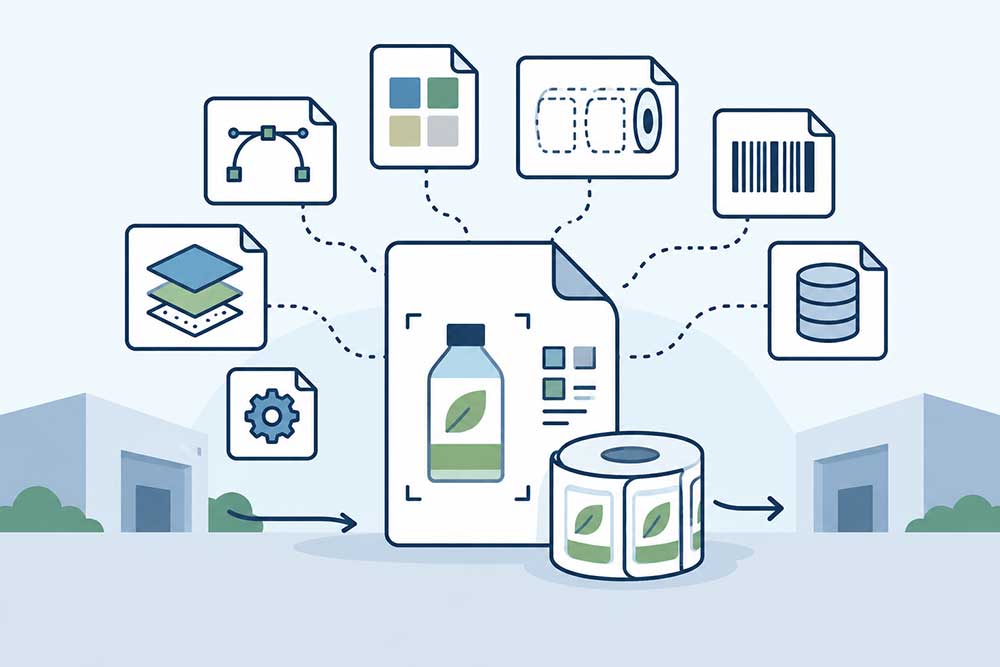
A well-documented label program can include far more information than a PDF of the artwork.
Depending on your labels and printing process, you may need access to:
- Current approved artwork and revisions
- Label dimensions and construction specifications
- Facestock, adhesive, liner, and material specifications
- Approved color standards and references
- Finishing specifications
- Embellishment requirements
- Die-cut specifications
- Tooling information
- Plate information where applicable
- SKU and version history
- Order quantities and historical usage
- Variable data requirements
- Serialization information
- Barcode specifications
- RFID specifications and data requirements
- Packaging and shipping specifications
- Quality requirements and approved samples
Not every label program will require every item on this list. The important part is knowing which information is critical to yours.
If you can’t answer that question until you’re already trying to leave a supplier, you’re starting the transition too late.
Why is Label Data so Valuable?
Your label data is more than production information. Over time, it can become a detailed record of how your business operates.
Consider what years of label orders can reveal.
Which SKUs run most frequently? Which products have seasonal spikes? Which labels are routinely ordered on short notice? How often does artwork change? Which materials are being used across multiple products? Where are you carrying unnecessary variation? How accurately are you forecasting demand?
Across a high-volume label program, ordering and production history can reveal patterns that aren’t obvious from individual purchase orders.
That creates an important question for brands:
Are you getting useful insights back from all that data?
A strong label supplier shouldn’t just know how to produce yesterday’s order again. Your supplier should be able to help you understand your label program and identify opportunities to make it easier to manage.
Why Can Switching Label Suppliers Become Difficult
Changing label printers can become difficult when important specifications, records, approvals, or data aren’t readily available to the customer.
That doesn’t automatically mean a supplier is intentionally locking a customer in.
Label manufacturing is complicated. Information may have accumulated over years. Employees change. Artwork gets revised. Specifications evolve. Different systems may hold different pieces of the production history.
But regardless of why the information is difficult to retrieve, the business impact can be the same.
Your new supplier may have to reconstruct specifications, reapprove colors, identify materials, recreate tooling, validate variable data, or repeat testing.
That means more time, more work, and potentially more risk.
The best time to find out what information you have is before you need it.

What Label Files Should You Have Before Switching Printers?
Before changing label suppliers, create a transition package for each active SKU or product family.
At minimum, confirm that you have the current approved artwork, dimensions, material construction, color requirements, finishing requirements, and any barcode, variable data, serialization, or RFID requirements needed to reproduce the label.
For more complex programs, you may also need historical information.
For example, knowing that a label uses a specific material is helpful. Knowing why that material was selected can be even more valuable.
- Was it chosen because the package gets refrigerated?
- Does the label need to survive moisture?
- Is it applied to a difficult container?
- Was a previous material tested and rejected?
- Does the application equipment require a specific construction?
- A specification tells a new printer what you’re buying. Good documentation can also tell them why.
That context can prevent expensive mistakes during a supplier transition.

What About Dies, Plates, & Tooling?
Tooling deserves special attention because assumptions about ownership can create surprises during a transition.
Ask your current printer what physical and digital production assets exist for your labels and what your agreement says about them.
Questions worth asking include:
- Who paid for the tooling?
- Who owns it?
- Can it be transferred?
- Is it compatible with another printer’s equipment?
- How long is it retained?
- Would a new supplier need to recreate it anyway?
Getting clear answers early allows you to calculate the actual cost and timeline of moving your label program.
The same principle applies to printing plates and other production-specific assets.
What About Variable Data and Serialized Labels?
Variable labels add another layer of complexity.
Instead of every label carrying identical information, individual labels may contain unique barcodes, numbers, identifiers, or other data. That makes data management part of the manufacturing process.
Before changing suppliers, understand how that information flows through your current program.
Ask:
- Where does the original data come from?
- Who generates unique identifiers?
- What data is provided by your company?
- What information is generated during production?
- What records are retained after labels are produced?
- What would a new printer need to continue the program without interruption?
Don’t assume the artwork file contains everything necessary to reproduce a variable label.
Often, it doesn’t.

RFID Makes Data Portability Even More Important
RFID labels and RFID-enabled packaging can make supplier transitions even more data-dependent.
An RFID program may involve retailer requirements, EPC data, serialization, encoding, validation, reporting, and integration between physical labels and digital information.
The RFID inlay itself is only one piece of the program.
Before switching an RFID label supplier, brands should understand their current data management process, retailer requirements, encoding specifications, testing requirements, and responsibilities between each party.
The goal isn’t simply to reproduce a label that looks the same.
The new RFID label has to work the same way too.
That includes meeting applicable retailer and program requirements.
How Do You Know if Your Label Program is Too Dependent on One Supplier?
Imagine your current label supplier became unavailable tomorrow. Could your team give another qualified printer enough information to begin reproducing your labels?
If the answer is no, figure out what’s missing.
Some warning signs include relying on your printer as the only source for current specifications, not knowing which materials are being used, lacking centralized approved artwork, having unclear tooling arrangements, or not understanding how variable and RFID data is managed.
None of those issues necessarily means you should change suppliers. They mean you should understand your program better. A strong supplier relationship should be built on service and value, not dependency.
10 questions to ask your label printer
You don’t have to wait for an RFP to have this conversation.
Ask your label supplier these questions now:
- What specifications do you maintain for each of our active labels?
- Which files and information have we provided to you?
- What production information would we need if we changed suppliers?
- Who owns our dies, plates, and tooling?
- Which production assets can and cannot be transferred?
- How are artwork revisions and approvals documented?
- How is variable or serialized data managed?
- How is RFID data managed, if applicable?
- What historical ordering and usage information is available to us?
- What would you provide to make a supplier transition easier?
A strong supplier should be able to help clarify these questions.

Don’t Wait for an RFP to Understand Your Label Data
Supplier transitions happen for all kinds of reasons.
Pricing changes. Capacity changes. Companies consolidate vendors. Requirements evolve. A new product needs capabilities the incumbent printer doesn’t have. Procurement decides to test the market.
Whatever the reason, you don’t want the first stage of an RFP to become a scavenger hunt for information about your own labels.
Build a clear record of your label program while things are going well.
- Know what data exists.
- Know where it lives.
- Know what your agreements say.
- Know what another supplier would need.
And expect your label partner to help make your program easier to understand, not harder.
At Meyers, we believe the strongest supplier relationships are built on expertise, communication, and trust. Whether you’re evaluating your current label program or considering a new supplier, our team can help you understand what it takes to make the transition without unnecessary disruption.
The strongest supplier relationships give brands reasons to stay through service, expertise, and value.
Frequently Asked Questions About Label Data and Switching Printers
Ownership depends on how the artwork was created, who created or supplied it, and the agreements between the brand and printer. Review your contracts and confirm what files your company can access before beginning a supplier transition.
It depends on the ownership agreement and whether the tooling is compatible with the new printer’s equipment. Ask who owns each asset, whether it can be transferred, and whether recreating it will be necessary.
A new printer will typically need approved artwork, label dimensions, material and adhesive requirements, colors, finishing specifications, quantities, application requirements, and relevant barcode or variable data requirements. More complex labels may require additional specifications and testing.
RFID programs may require information about inlays, encoding, EPC or serialization data, retailer compliance requirements, testing, validation, and data management processes. Confirm these requirements before transitioning production.
The timeline depends on the complexity of the label program, number of SKUs, availability of specifications and artwork, materials, tooling, testing requirements, approvals, and whether variable data or RFID is involved. Better documentation can make the transition significantly smoother.
Start before you plan to switch. Maintain current artwork and specifications, understand tooling arrangements, document materials and application requirements, know how variable data is managed, and keep a clear record of approved label versions. Then give prospective suppliers enough information to quote and plan the transition accurately.