
RFID and Sustainable Packaging: A Guide for Supply Chain Leaders

How is RFID Changing the Future of Sustainable Packaging?
Radio-Frequency Identification (RFID) technology is transforming the way packaging supply chains operate, making them more efficient, traceable, and environmentally responsible. As a result, in today’s marketplace, both brands and consumers expect greener, more ethical operations. Therefore, supply chain leaders need to understand not just the benefits of RFID but also its environmental trade-offs.
In this context, this guide offers practical insight for packaging leaders, sustainability managers, and brand teams seeking to integrate RFID-enabled packaging into their operations responsibly. With that in mind, Meyers can help you design and launch solutions that make your packaging both smart and sustainable.
What Is RFID and Why Is It Important for Sustainable Packaging?
RFID stands for Radio-Frequency Identification, a technology that uses radio waves to locate, identify, and track items. In practice, companies attach RFID tags to packaging, products, shipping containers, or reusable assets to gain real-time visibility across the supply chain.
Each RFID system has three main components:
- RFID tags contain microchips and antennas to store and transmit data.
- RFID readers capture tag data without requiring direct line-of-sight.
- RFID software collects, stores, and analyzes item data as it moves through production and distribution.
Unlike barcodes, which must be scanned one at a time and be visible to the reader, RFID tags can be read in bulk and at a distance. Because of this, companies can track items from manufacturing to retail, and even at end-of-life during recycling.
From a sustainability perspective, RFID can help reduce waste, optimize resources, and enhance transparency. However, because RFID tags use electronics and specialty materials, they also require careful end-of-life management to ensure a net-positive environmental impact.
How Can RFID Make Packaging Supply Chains Greener?
To fully understand RFID’s role in sustainability, it’s important to break down its main environmental advantages:
Inventory Optimization
RFID gives supply chains real-time inventory visibility, which helps prevent overproduction, reduce the need for markdowns, and cut perishable waste.
- A pilot program revealed that RFID can reduce food waste by up to 20% in grocery operations.
- Another solution achieved tracking accuracy of 93–99%, enabling effective FEFO (First-Expired-First-Out) inventory management.
- Better visibility drives smarter restocking decisions and healthier margins, with fresher stock and less waste.
Waste Reduction
- Improves sorting accuracy at recycling plants, increasing material recovery.
- Tracks reusable containers so they return more often, reducing single-use packaging waste.
- For instance, beverage brands use RFID to manage reusable kegs, lowering losses and costs.
♻ RFID and Improved Recycling Plant Sorting
RFID-enabled sorting pilots show big gains in accuracy and traceability, which supports higher-quality material recovery.
- A smart-sorting pilot reported accuracy rising from under 30% to over 85%.
- Facilities adopting digital tracking (including RFID) reported up to an 85% increase in material traceability.
Higher accuracy and traceability support cleaner streams and better recovery value.
Paper and Label Reduction
RFID replaces the need for multiple barcodes, printed forms, and labels, allowing digital tracking without wasteful printing.
- Warehousing operations report that RFID can reduce paper usage, such as logs, receipts, and labels, by up to 50%.
- Fewer printed materials means less deforestation and lower waste, improving both sustainability and efficiency.
Circular Economy Enablement
RFID enables real-time lifecycle tracking, from production to reuse, making take-back systems more scalable and effective.
- A European reuse initiative using RFID tags helped participants reduce packaging waste by 15% by 2040, enabling efficiency and accountability.
- Better lifecycle visibility accelerates circularity by powering reuse and take-back programs with confidence.
Lower Carbon Footprint
- Enables efficient delivery routing and optimized truckloads.
- As a result, many retailers have cut transportation emissions by reducing emergency shipments.
♻ RFID and Reduced Transportation Emissions
When retailers reduce stockouts with RFID, they avoid urgent, small-load restocks. Fewer emergency trips typically mean fewer miles and lower transport emissions.
- A Walmart field study found RFID cut out-of-stocks by 16% overall across 29 weeks and 24 stores.
- A follow-on analysis reported up to a 30% reduction in out-of-stocks for products selling 0.1–15 units/day.
Fewer stockouts ⇒ fewer urgent replenishment trips ⇒ lower transport emissions.
Transparency and Consumer Trust
RFID tracks product origin, materials, and lifecycle, empowering brands to share transparent sustainability data.
- A sustainable RFID label recognized by recyclers (APR Design for Recyclability) helps ensure high‑quality PET recovery, gaining approval in over 90% of North American CPG brands committed to recyclability.
- This reassures consumers and regulators that RFID-tagged products are both traceable and recyclable.
What Are the Steps in an RFID-Enabled Packaging System?
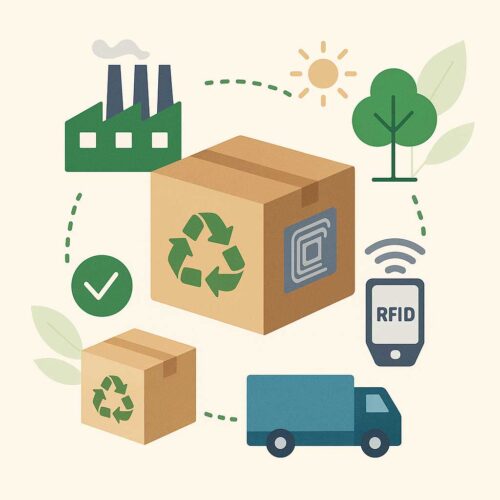
In practice, RFID-enabled packaging typically moves through four stages:
- Tag Integration RFID tags are applied during manufacturing in locations that enable easy scanning and limit recycling interference.
- Data Capture As products move through production, storage, and distribution, RFID readers automatically collect data.
- Analytics and Optimization Software use this data to improve inventory management, plan shipments, and identify waste-reduction opportunities.
- Lifecycle and End-of-Life Management RFID assists with sorting for recycling or reuse, supporting circular economy initiatives.
Example in Action: A personal care brand places RFID labels on shampoo bottles made from recycled materials. These bottles are tracked from the factory to store shelves. When returned for recycling, staff scan the RFID tag to verify the item, making the take-back program more efficient and accurate.

Sustainability Challenges and Solutions: RFID Trade-Offs
While RFID delivers strong sustainability gains, it also comes with challenges that need targeted solutions.
Material Waste and E-Waste
- Non-biodegradable plastics can break down into microplastics.
- Metals and silicon contribute to e-waste that requires specialized handling.
- Mixed materials in packaging can reduce recycling quality.
Solutions: Use biodegradable inlays, metal-free antennas, and detachable tags, while selecting sustainable label and carton materials and partnering in e-waste recovery programs.
Resource and Energy Intensity
- RFID production can require large amounts of energy and water.
- Fossil fuel-based manufacturing increases the carbon footprint.
Consequently, sustainable sourcing and process improvements are essential.
Solutions: Partner with RFID suppliers like Meyers, who power operations with renewable energy, prioritize lightweight tag design, and apply lifecycle assessments when appropriate.

Recycling Compatibility
- Tags can be difficult for recycling systems to detect or remove.
- Small tags may escape sorting altogether.
Solutions: Provide removal instructions, place tags strategically, and support recycling standardization.
Cost and Scalability
- Eco-friendly tags can be more expensive or less durable.
- Therefore, brands should adopt a phased approach to minimize disruption.
Solutions: Phase in sustainable tags where feasible, collaborate with other brands for bulk pricing, and invest in ongoing R&D.
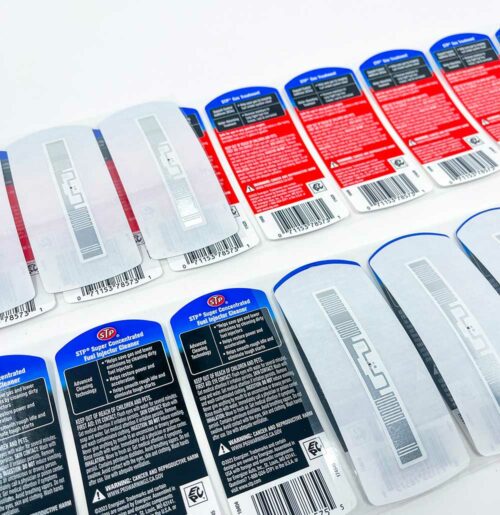
Design and Sustainability Considerations for RFID Tags
To align RFID technology with environmental goals, brands should:
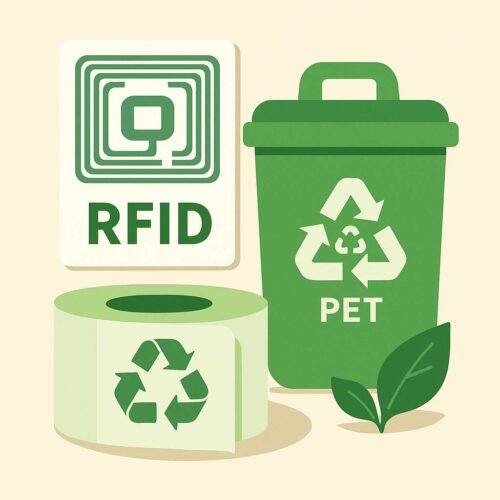
- Use APR-approved RFID tags for PET plastics.
- Select compostable or biodegradable materials where possible.
- Minimize tag size to reduce resource use.
- Position tags away from recycling-sensitive areas of the package.
- Explore chipless or paper-based designs with fewer metals and plastics.
- Partner with recyclers to validate recyclability in real conditions.
- Choose sustainable label and carton materials that are certified for recyclability or compostability.
For example, beverage makers in Europe have adopted APR-certified RFID labels for PET bottles, ensuring both supply chain tracking and recyclability.
Best Practices to Maximize Sustainability with RFID
To achieve the greatest environmental benefits, brands can:
- Choose tags that are easy to remove, recycle, or compost.
- Apply RFID to reusable packaging in closed-loop systems.
- Train teams on sustainable RFID sourcing and application.
- Audit packaging regularly as technology and regulations evolve.
- Use RFID data to optimize logistics and reduce emissions.
- Share sustainability results to build credibility and trust.

Why Partner with Meyers for RFID & Sustainable Packaging
With over 75 years of experience, Meyers specializes in helping brands integrate RFID-enabled sustainable packaging into their supply chains. Specifically, Meyers:
- Develops recyclable and compostable label solutions.
- Structurally designs packaging for efficiency and recyclability from start to finish.
- Leads innovation in embedded RFID solutions and circular economy systems.
- Provides full project support from concept to post-launch optimization.
If your goal is smarter, greener packaging, Meyers can help you achieve it.
Looking Ahead: The Future of RFID in Sustainable Packaging
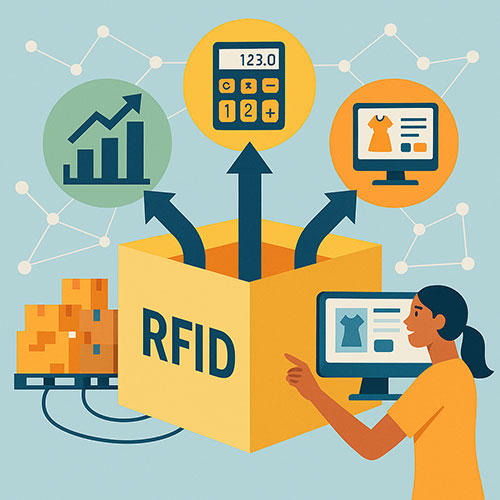
Going forward, the next generation of RFID technology will focus on:
- Chipless RFID designs that cut down on e-waste.
- Fully recyclable smart labels for consumer goods.
- Blockchain integration for greater transparency.
- Global recycling protocols for RFID-tagged products.
By addressing current challenges while innovating for the future, RFID can become a cornerstone of sustainable packaging and supply chain operations. Ultimately, the brands that start now will be the ones leading the industry tomorrow.
Related Content
- Walmart RFID Mandate: What Suppliers Need to Know
- Smart Packaging Technology: Future Trends and Predictions
- How to Choose the Right RFID Supplier for Your Brand
- RFID Technology: Supply Chains for CPG Brands
- RFID Mandates 101: Retail’s Future After the Walmart Mandate
- What Are RFID Labels? Benefits, Types, How They Work
- Leading CPG Brands Can Embed RFID Within Primary Product Labels via Meyers’ New Technology
FAQs
RFID stands for Radio-Frequency Identification. In packaging, RFID uses small tags with microchips and antennas to store and transmit data about an item. RFID readers capture this information without direct contact, allowing companies to track products from manufacturing to retail, and even into recycling programs.
RFID packaging helps brands reduce waste, optimize inventory, and improve recycling efficiency. By tracking items in real time, companies can avoid overproduction, cut transport emissions, and run take-back programs that recover more reusable packaging.
-Less overproduction: through accurate inventory tracking.
-Reduced waste: by improving the recycling plant sorting.
-Lower carbon emissions: from optimized transport routes.
-Fewer paper labels and forms: due to digital data storage.
-Better circular economy programs: through item-level tracking.
-Use paper-based, biodegradable, or compostable label materials.
-Reduce tag size to limit material use.
-Choose metal-free antennas.
-Place tags where they can be easily removed during recycling.
-Partner with recyclers to test RFID packaging performance.
Some RFID tags use plastics, metals, and microchips that can be hard to recycle. Manufacturing tags can require significant energy and water. Tags on certain packaging types may be difficult for recycling equipment to detect or remove.
Last Updated on September 3, 2025